
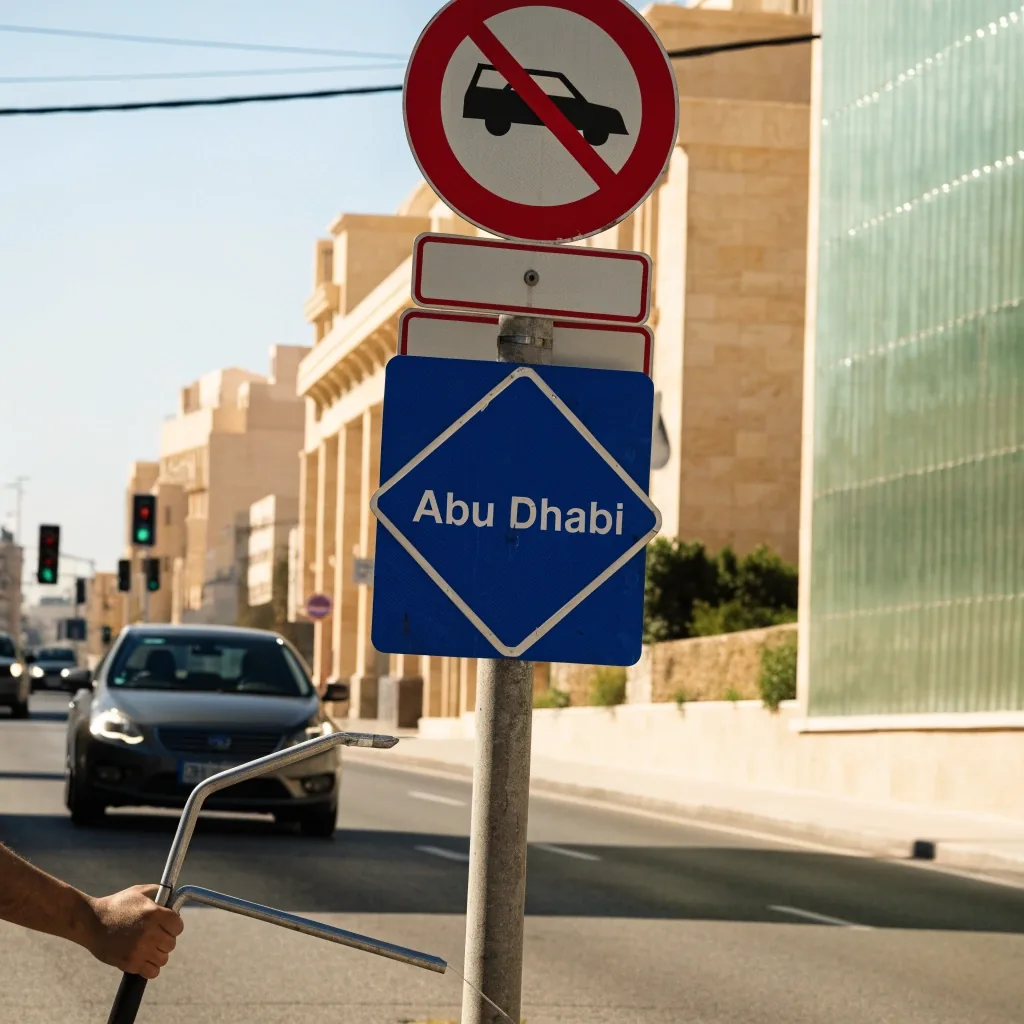
Salik, road signs and driving between the emirates
Two things make a Dubai to Abu Dhabi drive predictable: how Salik works, and how to read the signs.
Start with the toll systemRead the road before you drive it
Driving between Dubai and Abu Dhabi is straightforward once you know two things: how Salik works and how to read the signs. This page covers the toll system, the signage conventions you'll meet on inter-emirate routes, and the practical habits that keep a Dubai to Abu Dhabi drive predictable.
Most of what goes wrong on the route is not the driving. It is arriving at an exit one lane too late, or discovering after the fact that a gate was on the road you took. Both are fixable with about ten minutes of reading before you set off — and that reading is what this page is for.
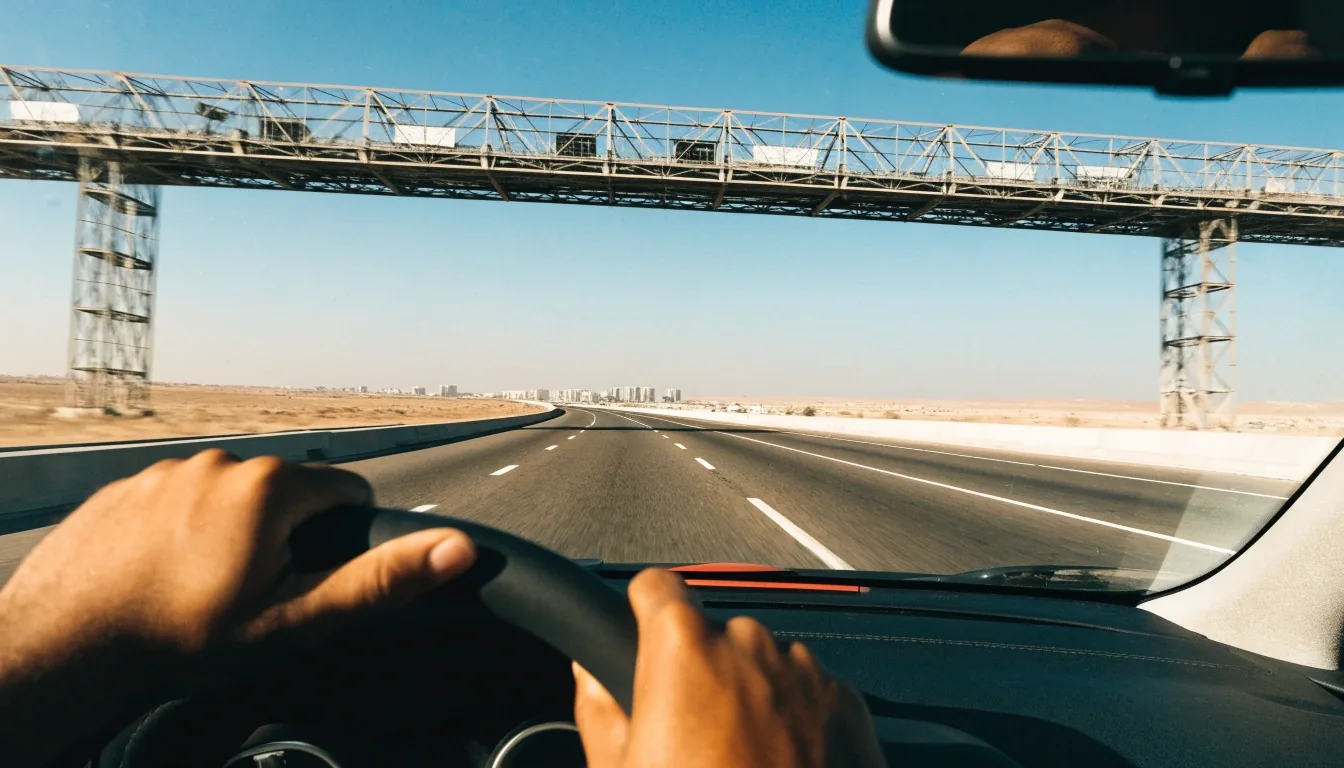
Salik is Dubai's road toll system. Toll gates sit on certain roads, and vehicles are charged automatically as they pass.
You do not stop. You do not pay at the gate.
The charge goes against your tag or your account, and the drive itself is unchanged. There is no barrier to raise and no transaction at the point of passing. What you manage is the account behind the tag, not the act of driving through.
If you drive in Dubai regularly, Salik is simply part of your cost of driving — a line in the same budget as fuel and parking. If you are visiting, or crossing Dubai on your way somewhere else, it is worth knowing which routes include a gate before you set off rather than after.
- Which roads on your route carry a gate, and whether your navigation app is showing them.
- Whether your tag or account balance can cover the trips you have planned this week.
- Whether the toll road is also the faster road at the hour you are travelling.
An automatic charge, and a system that reads your vehicle
Gates are signed clearly enough that you will see them coming, and the system reads your vehicle as you pass beneath. There is no lane to choose and no ticket to take. The main thing to manage is your account balance or tag setup — not the drive itself.
Navigation apps often show toll gates on a route, which helps you anticipate them. That marking is useful in both directions: it tells you the trip has a cost, and it tells you that you are on the road the app considers fastest.
Because the charge is automatic, a low balance is the one thing that turns a routine crossing into an administrative problem. Top it up on a schedule rather than in a panic.
Route around a gate, or just budget for it?
You can route around Salik gates, and apps will sometimes offer it. In practice, the detour usually costs more time than the toll is worth, especially at peak hours. A longer way around the city is not a saving if it puts you into the traffic the toll road was built to bypass.
The better use of toll information is budgeting and prediction, not avoidance. Knowing a gate is on your route tells you the trip has a cost and, sometimes, that you are on the faster road. Treat the gate as a fact about the journey rather than a problem to solve.
The exception worth knowing: if you are crossing Dubai without a Dubai destination — a long transfer, an airport run at an odd hour — it is worth comparing the tolled and untolled options once, on a quiet day, so you have a real sense of the time difference rather than a guess.
A toll is a small, known cost. A badly timed detour is a large, unknown one.
This is why most drivers on the Dubai to Abu Dhabi run stop trying to dodge the gate and start planning around the hour instead.
E11 and E311: two ways between Dubai and Abu Dhabi
The E11 is the primary artery between Dubai and Abu Dhabi. The E311 is the alternative, and which one your route uses shapes where slowdowns appear and whether a Salik gate is on your path. Knowing the route number matters because signage refers to them — if you already know you are aiming for the E11 or the E311, the signs become a confirmation rather than a puzzle.
Both connect Dubai and Abu Dhabi. Which one your route uses affects where traffic builds up — and on some trips, whether a Salik gate sits between you and the border.
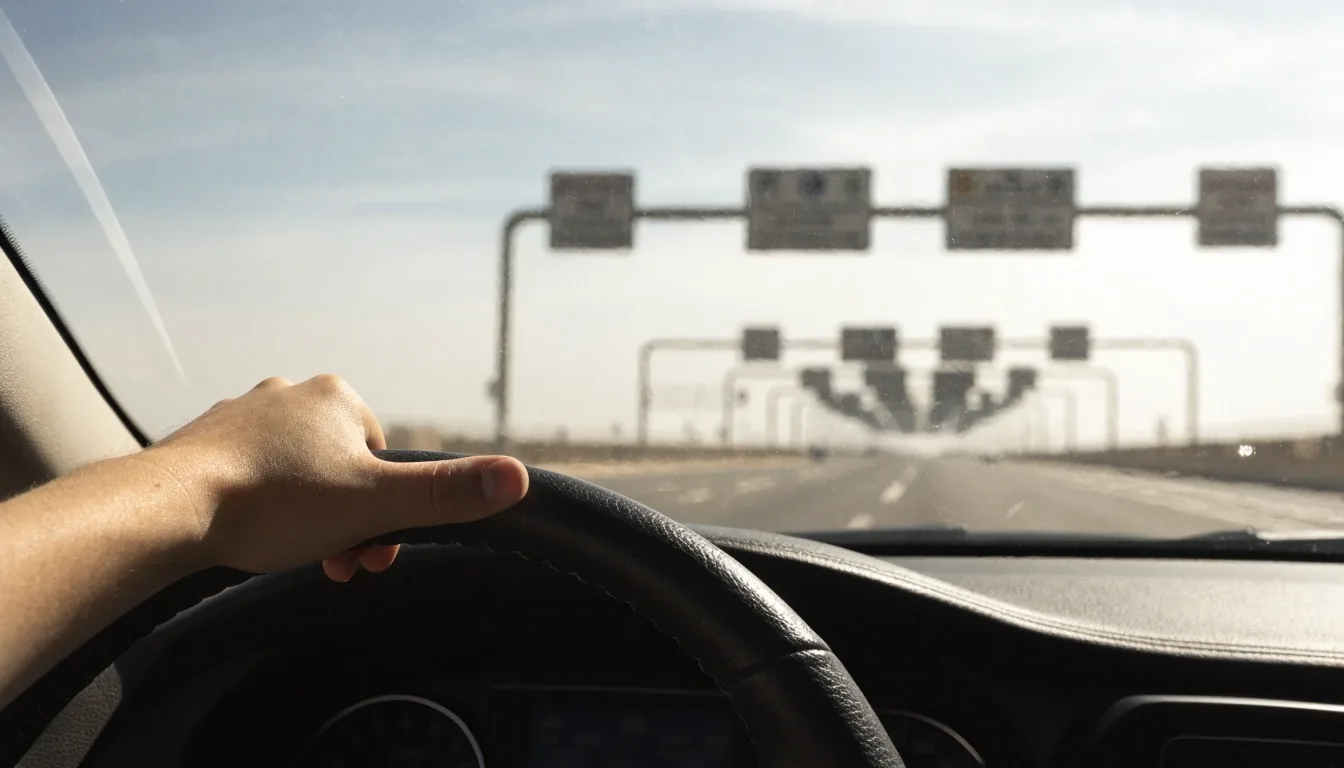
Signs here are short on words and heavy on symbols and route numbers. They are designed to be read at speed.
Reading Abu Dhabi traffic signs at speed
Abu Dhabi drivers rely on multilingual road signage and formal lane guidance. Road sign understanding matters for both city and highway driving, and it is one of the first things new drivers here need to get comfortable with.
Traffic sign guides get updated as new interchanges open, so it is worth a refresher if you are new — or if you have been driving the same short stretch for years and have not looked up lately.
Route numbers carry the message
A sign is more likely to tell you E11 or E311 than it is to spell out a distant city. If you know your number, the sign answers a question you already asked.
Multilingual by design
Arabic and English sit together on the same panel, with the symbols doing the heaviest lifting. Read the layout before you read the words.
Lane arrows come early
Formal lane guidance means the lane you need for an exit is often signed well in advance — sometimes a kilometre before the turn itself.
Warnings are wordless
Roadworks, closures and deviations arrive as symbols and colour. A red-bordered mark ahead of you is worth more attention than any place name.
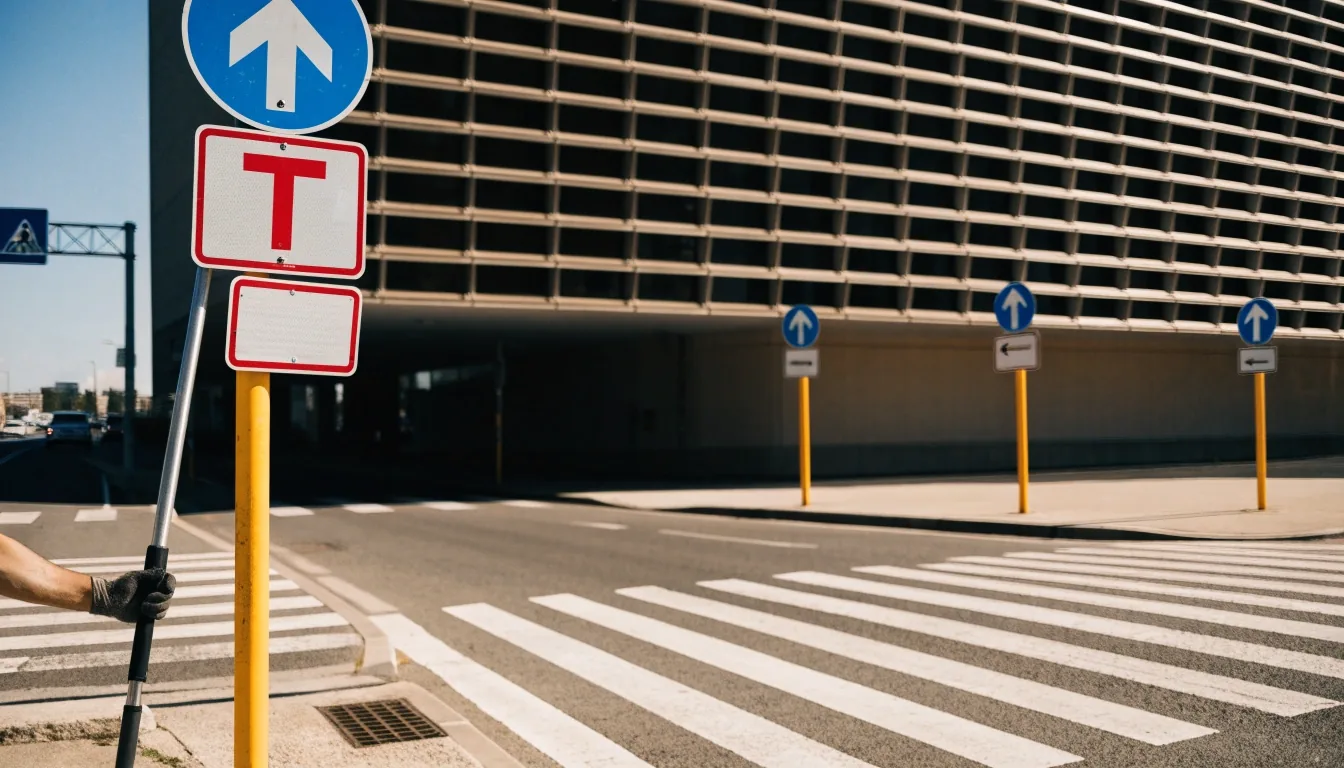
Get into the right lane before the signs start
On highways, staying in the correct lane early avoids the last-second merge that causes most of the stress on an unfamiliar route. The signed guidance is generous — but only if you are already looking for it. If you are driving the route for the first time, give yourself the right lane before the exit signs start, not after.
Navigation apps help here, but the signs are the authority. An app may re-route you for traffic that has already cleared; the gantry above your head is describing the road you are actually on.
A useful habit on inter-emirate routes: pick your lane at the start of each signed sequence and hold it until the next one. Weaving between lanes to gain a few car lengths costs more attention than it saves time, and on a 90-minute run that attention is worth more than the gap.
- 01 Read up on the sign conventions before your first inter-emirate drive.
- 02 Set your route and check whether it uses the E11 or the E311 — and whether a Salik gate is involved.
- 03 Drive the route in daylight the first time if you can.
- 04 Expect the second trip to feel much easier — the sequence of exits is what familiarity buys you.
What changes when you leave Dubai
Toll rules are Dubai's; the road you drive afterwards is not. That single fact explains most of the confusion on the Dubai to Abu Dhabi run — a gate charges you as you leave, and then a different emirate's signage takes over for the rest of the trip.
Salik stays a Dubai matter
Gates are positioned on certain Dubai roads. Once you are past them, the toll system has nothing more to say about your journey.
Signage changes hands
Abu Dhabi's road signage follows its own conventions — multilingual panels, formal lane guidance, heavy use of route numbers and symbols.
The route numbers stay put
E11 and E311 mean the same thing on both sides. That continuity is the one thread you can hold onto across the whole drive.
Your habits should not
Lane discipline, early exit positioning and reading the gantry work identically in both emirates. The system changes; the method does not.
It helps to think of the drive in two parts: the Dubai portion, where the toll system is the thing to plan around, and the inter-emirate portion, where reading the signs is the thing to plan around. Different skills, same road.
A five-minute check that makes the drive predictable
Read up on the sign conventions before your first inter-emirate drive. Set your route in your navigation app, and check whether it uses the E11 or the E311 and whether a Salik gate is involved. Then drive the route in daylight the first time if you can — the roads are well signed, but familiarity with the sequence of exits makes the second trip much easier.
None of this is complicated. It is simply the difference between arriving at an exit already knowing which lane you want, and arriving at it reading the signs for the first time at speed.
Answer these four before you turn the key and the drive stops being a series of surprises.
Tolls and signs, answered plainly
Three questions that come up most often from drivers making the Dubai to Abu Dhabi run for the first time.
How do I avoid Salik tolls when planning a route?
You can route around gates, but the detour usually costs more time than the toll. Most apps show toll gates on a route so you can see them before you start — use that to budget, not to dodge.
What's the difference between the E11 and E311?
Both connect Dubai and Abu Dhabi. The E11 is the primary artery, the E311 is the alternative. Which one your route uses affects where traffic builds up — and on some trips, whether a Salik gate is on your path.
Are Abu Dhabi road signs in English?
Signs are multilingual and use route numbers and symbols heavily. They are designed to be read quickly at speed, so the format is short and standardized — Arabic and English sit on the same panel.
Keep going with the rest of the guide
Tolls and signs are the start of the route, not the whole of it. If you are choosing the app you will actually drive with, the comparison covers how the main options behave on inter-emirate roads. If you would rather leave the car at home for part of the trip, the public transport guide covers the metro, tram and marine routes.
- Makani Address Guide
- Live Traffic and Roadworks
- Offline Maps Guide
- RTA Smart Drive Guide
- Back to the navigation guide
Questions about a specific route or crossing? Write to [email protected] or call +971 4 518 1085, Monday to Friday, 9:00 AM – 6:00 PM. Office 1403, Al Shatha Tower, Sheikh Zayed Road, Dubai.
Contact Sakilis